Summary
Short answer: Most APAC countries regulate cookies through their general privacy laws, not a cookie-specific law. So the rules depend on one question: does the cookie collect personal data, or data that someone can link to a person?
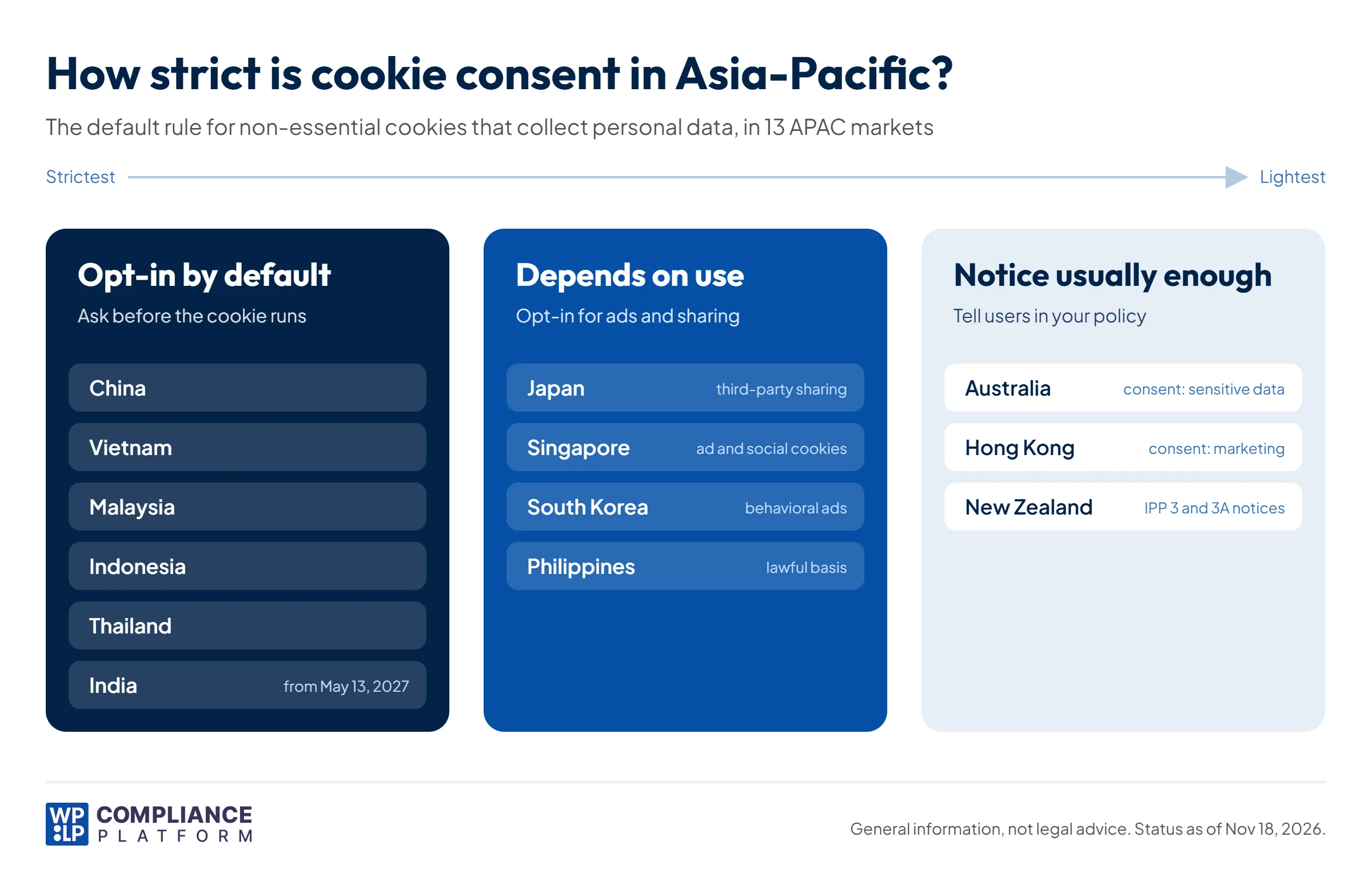
- Opt-in is the default for non-essential cookies that collect personal data in China, Vietnam, Malaysia, Indonesia and Thailand. India joins this group when its main DPDP duties start on May 13, 2027.
- Consent depends on the use in South Korea, Japan, Singapore and the Philippines. Behavioral advertising and data shared with third parties are the usual consent triggers.
- Notice is usually enough in Australia, Hong Kong and New Zealand, unless the data is sensitive or is used for direct marketing.
Penalties are going up. Australia’s maximum is now AUD 50 million or more, and South Korea can now fine up to 10% of total revenue in serious cases.
Cookie consent and privacy consent are different things
You run a WordPress site with visitors from Mumbai, Sydney and Singapore. Which cookie banner do they need?
The answer depends on a distinction that most APAC guides skip.
- Privacy consent is a legal basis to process personal data. Every law in this guide has a version of it.
- Cookie consent is permission to store or read a cookie on a device. The EU has a separate law for this (the ePrivacy Directive). No APAC country has a direct equivalent.
So in APAC, a cookie needs consent only when two things are true. The cookie collects personal data (or data linked to a person). And the local law has no other lawful basis or exception for that use.
A session cookie that keeps a cart open is usually fine without consent. An advertising pixel that builds a profile of a visitor across sites usually is not.
This guide covers 13 markets: Japan, Australia, India, Singapore, South Korea, China, Hong Kong, New Zealand, Malaysia, Vietnam, Indonesia, Thailand and the Philippines.
Why APAC cookie compliance matters more in 2026
Three changes since 2024 have raised the stakes for site owners.
1. New laws are now in force or about to start.
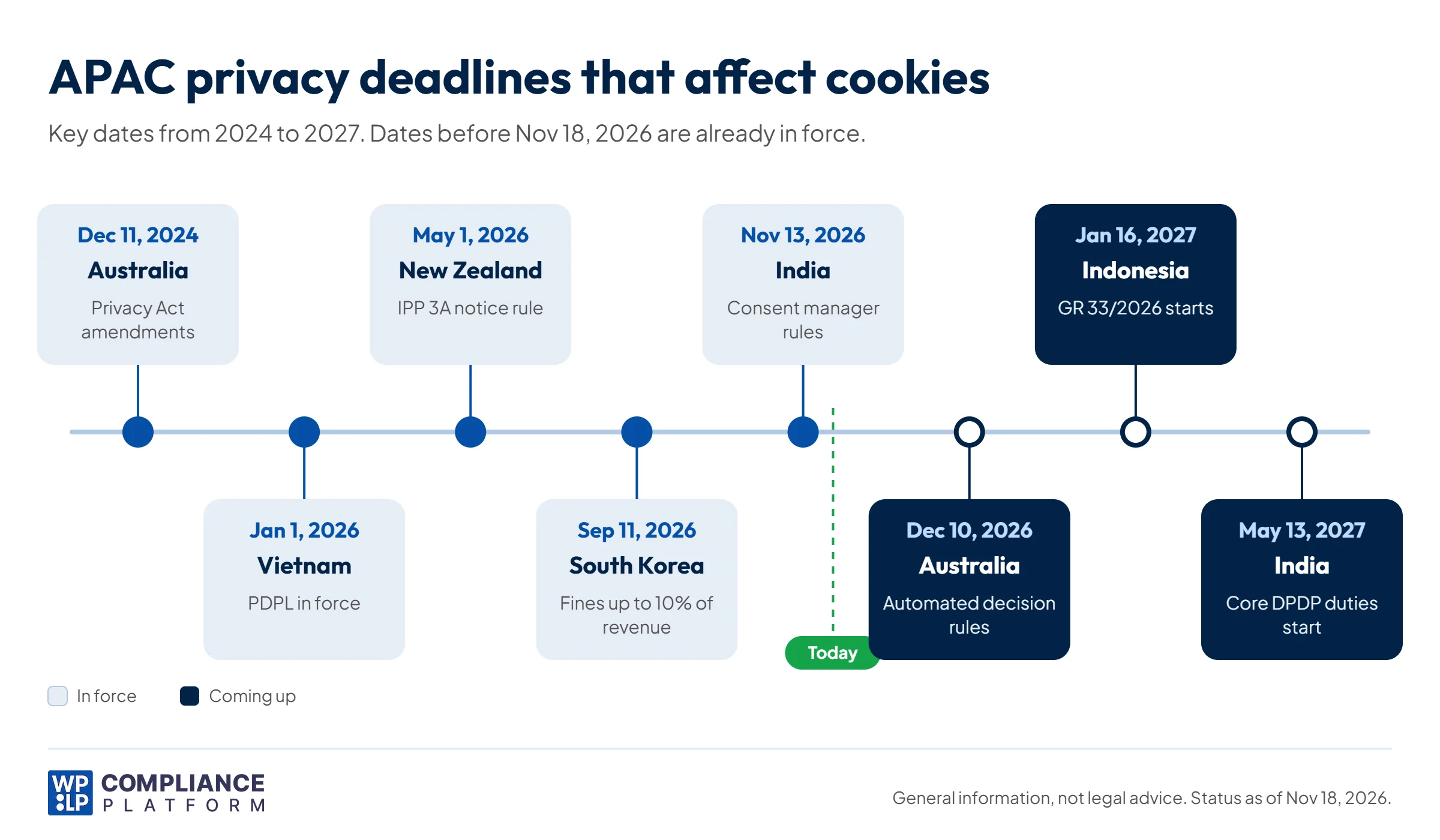
- Australia’s Privacy and Other Legislation Amendment Act 2024 took effect on December 11, 2024. It added new penalty tiers and infringement notices.
- Vietnam’s Personal Data Protection Law took effect on January 1, 2026.
- New Zealand’s IPP 3A took effect on May 1, 2026.
- South Korea’s higher fine cap of up to 10% of total revenue took effect on September 11, 2026.
- India’s DPDP Rules were notified on November 13, 2025. The main consent and notice duties start on May 13, 2027.
- Indonesia’s implementing regulation (GR 33/2026) takes effect on January 16, 2027.
2. Regulators have fined tracking practices directly. In September 2022, South Korea’s Personal Information Protection Commission (PIPC) fined Google and Meta a combined KRW 100 billion (about USD 72 million). The PIPC found that both companies collected visitors’ behavioral data from other websites without valid consent.
3. Laws are similar in direction but different in detail. Most new APAC laws take ideas from the EU’s GDPR: clear notices, purpose limits, user rights and consent records. But each country sets its own lawful bases, exceptions and transfer rules. One cookie banner setup rarely fits every market.
Country-by-country rules
Each entry answers the same five questions: which law applies, when cookies need consent, what exceptions exist, what the penalty is, and what to do on your site.
1. Japan
Laws: Act on the Protection of Personal Information (APPI) and the Telecommunications Business Act (TBA).
When cookies need consent: A cookie ID alone is usually not personal information under the APPI. Three rules can still apply:
- Cookie data linked to a known user (for example, a logged-in account) is personal information. You must state the purpose of use, and you generally need opt-in consent before you give it to a third party.
- “Personally referable information” is cookie data that you can’t link to a person, but the recipient can. Since April 2022, the recipient must get the user’s consent, and you must confirm that before you send the data.
- The TBA external transmission rule (in force since June 16, 2023) covers businesses that the law lists, such as online shops, social networks and search services. When a tag on your page sends user data to a third party, you must give notice, get consent, or offer an opt-out. First-party cookies and data needed to run the service are exempt.
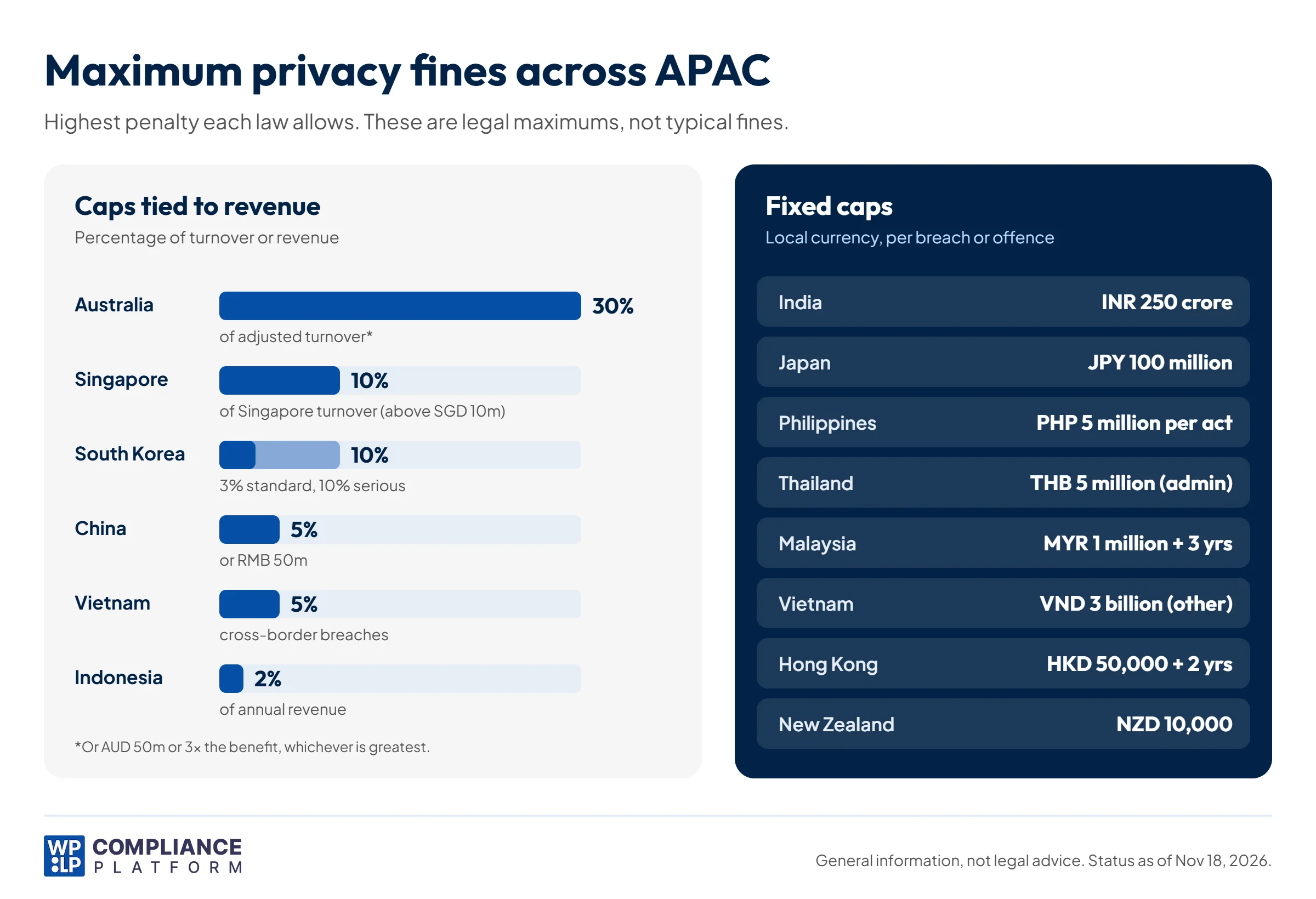
Penalties: If you break an order from the Personal Information Protection Commission (PPC), a company can be fined up to JPY 100 million. The Ministry of Internal Affairs and Communications (MIC) can order a business to correct how it handles TBA data.
What to do: Map which tags send data to third parties. Then publish a TBA notice, and get consent where a partner can identify users.
2. Australia
Law: Privacy Act 1988 and the Australian Privacy Principles (APPs), as amended by the Privacy and Other Legislation Amendment Act 2024 (in force since December 11, 2024).
When cookies need consent: There is no cookie-specific rule. The APPs apply when cookie data is “personal information” about an identified or reasonably identifiable person. You must give a collection notice (APP 5) and explain cookies in your privacy policy. Consent is required for sensitive information, such as health data. Direct marketing must include a simple way to opt out (APP 7).
Exceptions: Most businesses with annual turnover of AUD 3 million or less are exempt from the Act. Some are covered anyway, such as health service providers and businesses that trade in personal information.
Penalties (source):
- Serious interference with privacy: up to the greatest of AUD 50 million, 3 times the benefit obtained, or 30% of adjusted turnover.
- Non-serious interference (a new mid tier): up to AUD 3.3 million for a company.
- Infringement notices for some breaches: up to AUD 19,800 per breach for most companies, or AUD 66,000 for listed companies.
Coming next: Privacy policies must describe some automated decisions from December 10, 2026. The government has also agreed in principle to further reforms, such as ending the small business exemption. Those are not law yet.
What to do: A notice-style banner is acceptable for most cookies. Use opt-in for anything that collects sensitive data.
3. India
Law: Digital Personal Data Protection Act 2023 (DPDPA) and the DPDP Rules 2025.
Timing matters here. The Rules were notified on November 13, 2025, and start in 3 phases (source):
- November 13, 2025: rules for the Data Protection Board.
- November 13, 2026: registration rules for consent managers.
- May 13, 2027: the main duties for businesses, which include notice, consent, user rights, security and breach reporting.
So the DPDPA consent rules for cookies are not enforceable yet. Use the time to prepare.
When cookies need consent (from May 13, 2027): The DPDPA applies to digital personal data. Consent must be free, specific, informed, unconditional and unambiguous, given by a clear affirmative action. Withdrawing consent must be as easy as giving it. Notices must be in plain language, itemize the data and purposes, and be available in English or any of the 22 languages in the Constitution’s Eighth Schedule.
Exceptions: The Act lists a small number of “legitimate uses” (Section 7). One covers data a user gives voluntarily for a specific purpose. It has no general “legitimate interests” basis. The Act and Rules do not mention cookies, so cookies needed to deliver a service the user asked for may fall under a legitimate use. Get legal advice on this point.
Penalties: Up to INR 250 crore per breach for failing to protect data, and up to INR 50 crore for most other breaches. The Data Protection Board enforces the law.
What to do: Plan for an opt-in banner with per-category choices and an easy way to withdraw consent before May 2027.
4. Singapore
Law: Personal Data Protection Act 2012 (PDPA).
When cookies need consent: There is no cookie-specific law. If a cookie doesn’t collect personal data, you don’t need consent. If it does, you need consent or an exception. PDPC guidance says:
- Consent can be implied or “deemed” for cookies that run a function the user asked for, such as a shopping cart.
- A user’s failure to change browser settings is not consent to all cookies.
- Analytics and advertising cookies need consent only if they collect personal data. Social media cookies are harder to justify on deemed consent.
Exceptions: Since 2021, the PDPA has also allowed deemed consent by notification and a legitimate interests exception. Both need a documented assessment.
Penalties: Up to 10% of annual turnover in Singapore for organizations with turnover above SGD 10 million. Otherwise, up to SGD 1 million. The Personal Data Protection Commission (PDPC) enforces the law.
What to do: Run essential cookies without consent. Use opt-in for advertising and social media cookies that collect personal data.
5. South Korea
Law: Personal Information Protection Act (PIPA).
When cookies need consent: Cookie data is personal information when someone can identify a person from it, alone or by easily combining it with other data. Consent is the main lawful basis. PIPA also allows processing that is necessary for a contract, and some other bases. Your privacy policy must explain how you install and run cookies and how users can reject them (Article 30).
For behavioral advertising, the PIPC treats collecting visitors’ behavior across other websites as needing valid consent. That was the basis of the 2022 Google and Meta fines. In 2024, the PIPC announced plans to revise its targeted advertising guidelines.
Penalties: Up to 3% of total revenue for most breaches. Since September 11, 2026, the PIPC can fine up to 10% of total revenue in serious cases. These include repeated intentional or grossly negligent breaches within 3 years, breaches affecting 10 million or more people, and breaches after ignoring a PIPC corrective order.
What to do: Get opt-in consent before running ad or cross-site tracking tags. List every cookie and how to reject it in your privacy policy.
6. China
Law: Personal Information Protection Law (PIPL), in force since November 1, 2021.
When cookies need consent: Cookie data is generally treated as personal information. You usually need consent unless another legal basis applies, such as contract necessity. Continuing to browse is unlikely to count as consent. Cookie walls are a risk because consent must be freely given.
PIPL requires separate consent for sensitive data, sharing with another controller, and sending data outside China. If you use personal data for automated recommendations, you must also give users an easy way to refuse them.
Penalties: For serious breaches, up to RMB 50 million or 5% of the previous year’s turnover (Article 66). The Cyberspace Administration of China (CAC) leads enforcement.
What to do: Use opt-in for non-essential cookies. Get separate consent for any data that leaves China.
7. Hong Kong SAR
Law: Personal Data (Privacy) Ordinance (PDPO).
When cookies need consent: Generally, you don’t need consent to place cookies. You do need it when you use cookie data for direct marketing to a known person, for data matching, or for a new purpose unrelated to the original one. You must tell users the purpose of collection.
Penalties: A first conviction for breaking an enforcement notice can mean a fine of up to HKD 50,000 and 2 years in prison. The Office of the Privacy Commissioner for Personal Data (PCPD) enforces the law.
What to do: A notice with a link to your privacy policy is enough for most cookies. Get consent before you use cookie data for direct marketing.
8. New Zealand
Law: Privacy Act 2020.
When cookies need consent: The Act has no cookie consent rule. It requires notice. Information Privacy Principle 3 covers data you collect from the person. IPP 3A (in force since May 1, 2026) requires notice when you collect personal data from another source, such as an ad or analytics partner.
Penalties: Fines of up to NZD 10,000 for specific offences, such as destroying information after someone asks for it. Failing to report a notifiable privacy breach is also an offence. The Office of the Privacy Commissioner enforces the law.
What to do: Update your privacy policy to cover data you get from third-party tools.
9. Malaysia
Law: Personal Data Protection Act 2010 (PDPA), amended in 2024. The changes started in phases during 2025.
When cookies need consent: The PDPA covers personal data processed in commercial transactions. Consent is the general rule, with exceptions such as processing needed for a contract. Privacy notices must be in both Malay and English.
Penalties: Up to MYR 1 million, 3 years in prison, or both, for breaking the data protection principles. The 2024 amendments also added a mandatory data protection officer and breach notification. The Personal Data Protection Commissioner enforces the law.
What to do: Use opt-in for cookies that collect personal data. Publish your cookie and privacy notices in Malay and English.
10. Vietnam
Law: Personal Data Protection Law (Law No. 91/2025/QH15) and Decree 356/2025, both in force since January 1, 2026.
When cookies need consent: The law is consent-first and has strict rules for the form of consent. It adds some exceptions, such as processing needed for a contract. The law does not mention cookies directly. Treat cookies that collect personal data as needing opt-in consent.
Penalties (source):
- Cross-border transfer breaches: up to 5% of the previous year’s revenue.
- Illegal trading of personal data: up to 10 times the revenue from the breach.
- Other breaches: up to VND 3 billion.
The A05 department of the Ministry of Public Security enforces the law.
What to do: Use opt-in for non-essential cookies. If cookie data goes to servers outside Vietnam, file a transfer impact assessment.
11. Indonesia
Law: Personal Data Protection Law No. 27 of 2022 (in force since October 17, 2024) and Government Regulation 33 of 2026 (in force from January 16, 2027).
When cookies need consent: The law has 6 lawful bases, including consent and legitimate interests. Consent must be freely given, informed, specific and unambiguous. The law does not mention cookies, but cookie data that identifies a person is personal data.
Penalties: Administrative fines of up to 2% of annual gross revenue, plus criminal penalties for some offences. The dedicated data protection agency is not set up yet, so the Ministry of Communication and Digital Affairs (Komdigi) enforces the law for now.
What to do: Use opt-in for tracking cookies. If you rely on legitimate interests, document why.
12. Thailand
Law: Personal Data Protection Act 2019 (PDPA), fully in force since June 1, 2022.
When cookies need consent: Thailand has no cookie-specific law. Strictly necessary cookies can rely on a contract basis without consent. Functional, analytics and advertising cookies generally need consent. Personalized advertising needs consent.
Penalties: Administrative fines of THB 500,000 to THB 5 million, depending on the breach. In August 2024, regulators fined an online retailer THB 7 million in total. Courts can also order punitive damages of up to 2 times the actual damages. The Personal Data Protection Committee (PDPC) enforces the law.
What to do: Use an opt-in banner with per-category choices. Run strictly necessary cookies without consent.
13. Philippines
Law: Data Privacy Act of 2012 (DPA).
When cookies need consent: The law has no cookie-specific rule. Cookie data that identifies a person is personal information, and processing needs a lawful basis such as consent, contract or legitimate interests.
Penalties: Administrative fines of 0.25% to 3% of annual gross income, capped at PHP 5 million per act. Criminal penalties include prison terms. The National Privacy Commission (NPC) enforces the law.
What to do: Use consent for advertising cookies. If you rely on legitimate interests for analytics, document the reason.
APAC cookie consent comparison table
Opt-in is the safe default for non-essential cookies in 6 of the 13 markets. Three markets mostly need notice only. The tables show the position as of November 18, 2026. Sources for each row are linked in the country sections above.
When cookies need consent
| Market | Cookies covered? | Opt-in for non-essential cookies? | Main exceptions |
|---|---|---|---|
| Japan | When linked to a person, or a recipient can link it | For third-party sharing of personal or personally referable data | First-party cookies and data needed for the service (TBA) |
| Australia | When the data is personal information | No, notice. Yes for sensitive data | Small business exemption (AUD 3m turnover) |
| India | Digital personal data | Yes, from May 13, 2027 | Section 7 legitimate uses |
| Singapore | When cookies collect personal data | For ad and social cookies that collect personal data | Deemed consent; legitimate interests |
| South Korea | When the data can identify a person | For behavioral advertising and cross-site tracking | Contract necessity and other bases |
| China | Cookie data is generally personal information | Yes | Contract necessity; legal duties |
| Hong Kong | When the data is personal data | No, notice | Consent only for direct marketing, matching or new purposes |
| New Zealand | When the data is personal information | No, notice (IPP 3 and IPP 3A) | Publicly available information |
| Malaysia | Personal data in commercial transactions | Yes, as the general rule | Contract necessity and others |
| Vietnam | Personal data | Yes | Contract performance and others |
| Indonesia | Personal data | Yes, unless another basis applies | Legitimate interests and 4 other bases |
| Thailand | Personal data | Yes, except strictly necessary | Contract basis for necessary cookies |
| Philippines | Personal information | For advertising; depends on the basis | Contract; legitimate interests |
Laws, penalties and regulators
| Market | Main law | Maximum penalty | Regulator |
|---|---|---|---|
| Japan | APPI; Telecommunications Business Act | JPY 100 million (breaking a PPC order) | PPC; MIC |
| Australia | Privacy Act 1988 (APPs) | Greatest of AUD 50m, 3x benefit, or 30% of adjusted turnover | OAIC |
| India | DPDPA 2023; DPDP Rules 2025 | INR 250 crore per breach | Data Protection Board |
| Singapore | PDPA 2012 | 10% of Singapore turnover, or SGD 1m | PDPC |
| South Korea | PIPA | 3% of total revenue; 10% in serious cases | PIPC |
| China | PIPL | RMB 50m or 5% of turnover | CAC |
| Hong Kong | PDPO | HKD 50,000 and 2 years (first conviction, enforcement notice) | PCPD |
| New Zealand | Privacy Act 2020 | NZD 10,000 per offence | Privacy Commissioner |
| Malaysia | PDPA 2010 (amended 2024) | MYR 1m and/or 3 years | PDP Commissioner |
| Vietnam | PDPL 2025 | 5% of revenue (cross-border breaches) | MPS (A05) |
| Indonesia | PDP Law 27/2022; GR 33/2026 | 2% of annual revenue | Komdigi (interim) |
| Thailand | PDPA 2019 | THB 5m (administrative) | PDPC |
| Philippines | Data Privacy Act 2012 | 3% of annual gross income, capped at PHP 5m per act | NPC |
Where APAC laws agree and where they differ
Where they agree:
- No APAC market has a standalone cookie law. Cookies fall under general privacy law when they collect personal data.
- Every market expects a clear privacy notice that explains what you collect and why.
- Behavioral advertising and data sharing with third parties get the most scrutiny.
Where they differ:
- Lawful bases. India has no legitimate interests basis. Indonesia, Singapore, the Philippines and South Korea have one in some form. This decides whether analytics cookies need consent.
- Language. India’s notices must be available in English or any of 22 scheduled languages. Malaysia requires Malay and English. An English-only banner can fall short in both.
- Timing. India’s main duties start on May 13, 2027, and Indonesia’s GR 33/2026 starts on January 16, 2027. Rules in both markets will keep changing.
Cross-border data transfers
Most cookie tools send data to servers in another country. Analytics and ad platforms almost always do. Transfer rules differ a lot:
- China: Transfers need separate consent and one of 3 mechanisms: a CAC security assessment, a CAC standard contract, or certification.
- Vietnam: You must prepare a transfer impact assessment, file it with the A05 department, and update it in some cases.
- India: Transfers are allowed, except to countries the government restricts. Significant Data Fiduciaries may face extra limits.
- Indonesia: Some transfer mechanisms depend on the new data protection agency, which does not exist yet.
- Malaysia: The 2024 amendments removed the whitelist. Transfers can go to countries with similar laws or with adequate safeguards.
How to set up cookie consent for APAC visitors
Step 1: Audit every cookie and tag
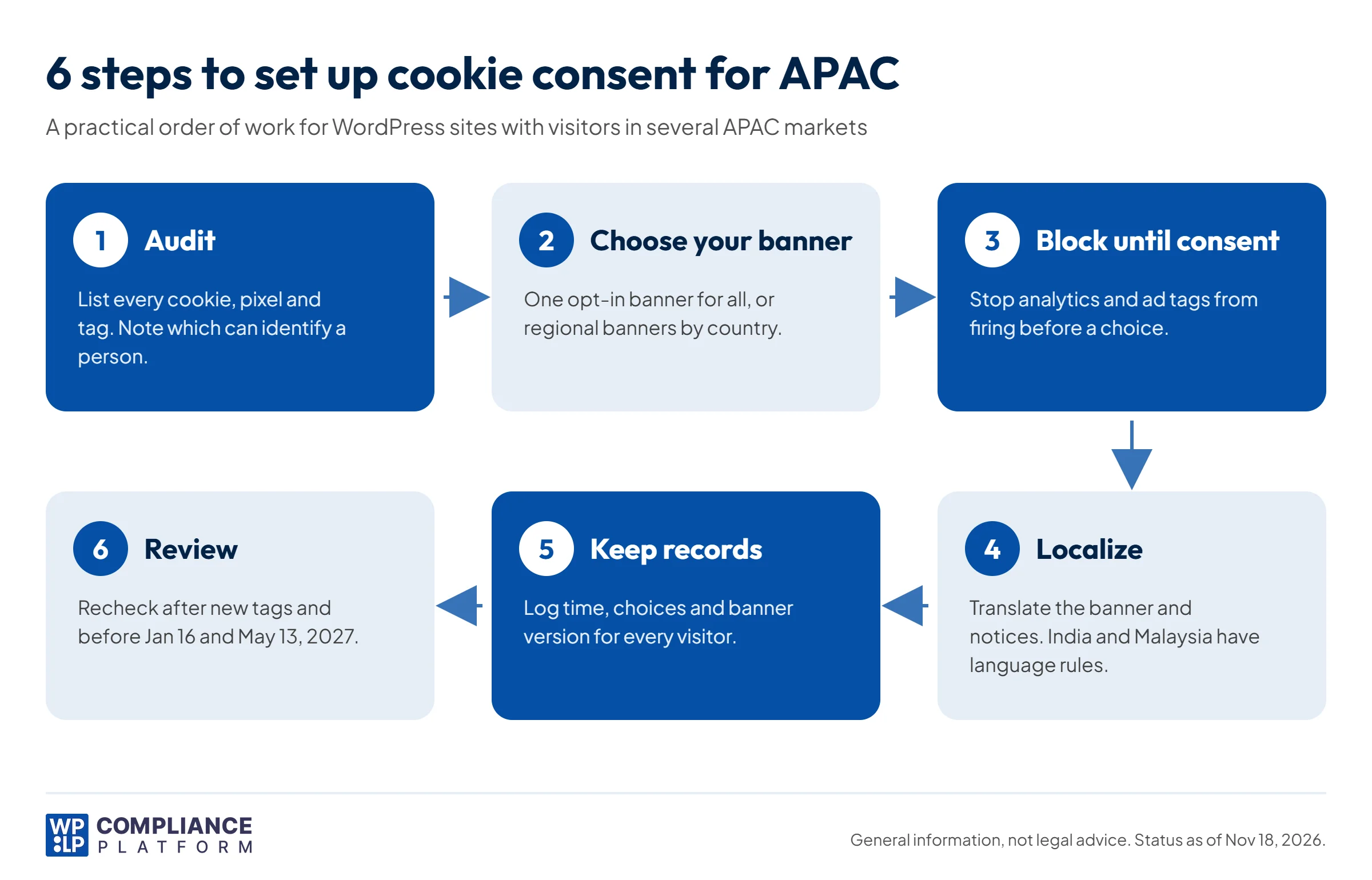
Scan every page template, not just the homepage. Record each cookie, pixel and local storage item:
- Name and provider (first party or third party).
- Purpose: strictly necessary, functional, analytics or advertising.
- What data it collects, and whether that data can identify a person.
- Where the data goes, including the provider’s country.
- How long it lasts.
The “can it identify a person” column decides most of your APAC obligations.
Step 2: Choose one strict banner or regional banners
You have two options:
- One opt-in banner for all visitors. It is simpler to run, and it meets the strictest market you serve. You may get lower analytics consent rates in notice-only markets such as Australia.
- Regional banners. Opt-in where the law needs it, and notice where it doesn’t. You get more data, but it takes more setup and needs reliable location detection. See our guide to geo-targeting cookie banners.
Step 3: Block non-essential cookies until the visitor chooses
In opt-in markets, analytics and advertising tags must not fire before consent. Test this. Load your site in a private window, open the browser’s developer tools, and check which cookies are set before you click anything.
Give “Accept” and “Reject” equal weight, and let visitors choose by category. Avoid dark patterns that push visitors toward “Accept”.
Step 4: Localize the banner and notices
Write the banner, buttons and cookie policy in the visitor’s language. India and Malaysia have specific language rules for notices.
Step 5: Keep consent records
For each choice, log the date and time, the categories accepted or rejected, the banner version, and a pseudonymous visitor ID. A full IP address is itself personal data, so store only what you need.
Step 6: Put review dates in your calendar
Three dates are coming up: December 10, 2026 (Australia’s automated decision disclosures), January 16, 2027 (Indonesia’s GR 33/2026) and May 13, 2027 (India’s main DPDP duties).
Example: one WordPress store selling to India, Singapore and Australia
This is an illustrative example, not a real customer case.
A small WordPress store sells handmade goods to buyers in India, Singapore and Australia. It uses 4 kinds of cookies and tags:
- A WooCommerce session and cart cookie (strictly necessary).
- Google Analytics 4 (analytics).
- Meta Pixel (advertising, sends data to Meta).
- Embedded YouTube videos (sets third-party cookies when played).
Here is how each one is treated:
| Cookie or tag | India (from May 13, 2027) | Singapore | Australia |
|---|---|---|---|
| WooCommerce cart | Likely no consent: may fit a Section 7 legitimate use (get legal advice) | No consent: deemed consent for a requested function | Notice in the privacy policy |
| Google Analytics 4 | Opt-in consent | Consent if it collects personal data, or document legitimate interests | Notice; give an opt-out if practical |
| Meta Pixel | Opt-in consent | Opt-in consent | Notice, plus opt-out for direct marketing; consent for sensitive data |
| YouTube embed | Opt-in before the video loads | Consent if personal data is collected | Notice |
The store’s decision: It uses one opt-in banner for all 3 countries. India will need opt-in from May 2027 anyway. Singapore needs it for the Meta Pixel. One banner means one setup to test and one set of consent records.
Consent records: The store logs each choice with a date and time, the categories chosen and the banner version. It keeps the records in its own database and links its cookie policy from the banner.
What the store still does itself: It reviews the cookie list after every new plugin or tag, and it rechecks the setup before May 13, 2027.
How WPLP Compliance Platform helps with steps 1 to 5
WPLP Cookie Consent is a WordPress plugin for steps 1 to 5 above. Here is what it does, by plan.
| Task | What WPLP does | Plan |
|---|---|---|
| Audit cookies | Scans the site and sorts cookies and scripts into categories. You can also add them by hand. | Free: 5 scans a month, up to 100 pages each. Paid plans raise the limits. |
| Block before consent | Blocks scripts and embeds until the visitor consents. Visitors can set preferences by cookie category. | Free |
| Localize | Shows the banner in the visitor’s browser language (50+ languages). | Free |
| Show banners by region | Geo-targeting shows or hides the banner for specific countries. | Paid |
| Choose the law | Pick a banner type by hand on any plan. Auto-detect law serves the matching banner by visitor location. In APAC, its built-in law set covers Australia (APP). | Manual: Free. Auto-detect and APP: Paid |
| Keep consent records | Logs each decision in your own WordPress database and syncs it to the WPLP web app. Visitors can revoke consent, and you can re-ask on a schedule. | Free |
| Handle data requests | A DSAR request form, admin alerts and a request queue. Automated data discovery and Access, Delete and Export processing on paid plans. | Form: Free. Processing: Paid |
| Ad platform signals | Google Consent Mode v2 and Global Privacy Control. IAB TCF v2.3 on paid plans. | Free / Paid |
What WPLP does not do for you
- It has no built-in banner preset for India, Singapore, Japan, South Korea, China or the other APAC markets in this guide. For those markets, set up an opt-in banner by hand and use geo-targeting to show it in the right countries.
- It does not decide your lawful basis or tell you whether a cookie collects personal data. You make those calls, ideally with legal advice.
- It does not translate or legally review your cookie policy text. Check the wording in each language yourself.
- It does not handle cross-border filings, such as Vietnam’s transfer impact assessment or China’s CAC mechanisms.
- WPLP gives you the controls and the records. Whether your site complies depends on how you set them up.
WPLP Legal Pages, from the same team, can generate the privacy policy and cookie policy pages your banner links to.
Frequently asked questions
No. China, Vietnam, Malaysia, Indonesia and Thailand generally expect opt-in for non-essential cookies that collect personal data. India will from May 13, 2027. Australia, Hong Kong and New Zealand mostly need notice. Japan, Singapore, South Korea and the Philippines depend on the cookie’s purpose and who receives the data.
Usually not. Cookies that run a feature the user asked for, such as a cart or login, are exempt or covered by another basis in most markets. List them in your cookie policy anyway.
The largest so far is South Korea’s 2022 fine of KRW 69.2 billion on Google and KRW 30.8 billion on Meta, for collecting behavioral data without valid consent. In Thailand, regulators fined an online retailer THB 7 million in 2024 for security and governance failures.
At least every 6 months, and whenever you add a new tag or plugin. Also review before these dates: December 10, 2026 (Australia), January 16, 2027 (Indonesia) and May 13, 2027 (India).
A consent tool such as WPLP can scan cookies, block tags before consent, show banners by region and keep consent records. You still need to decide the lawful basis for each cookie and check your policy text for each market.
Conclusion
APAC has no single cookie rule. The safe path for most multi-market sites:
- List every cookie and tag, and note which ones can identify a person.
- Use opt-in for advertising and cross-site tracking in every market.
- Block non-essential tags until the visitor chooses, and keep a record of the choice.
- Translate your notices where the law asks for it.
- Recheck your setup before India’s May 13, 2027 deadline.
Need help managing consent across several APAC markets? Start with WPLP Cookie Consent for free.
Disclaimer: This article is general information, not legal advice. APAC privacy laws change often. Check the primary sources and get advice from a qualified lawyer in each market before you rely on this guide.
Related reading
- India’s Digital Personal Data Protection Act
- Australian Privacy Principles
- Geo-targeting cookie banners
- Swiss Federal Act on Data Protection (FADP)
- Data privacy laws around the world
- Thailand’s Personal Data Protection Act (PDPA)
- New Zealand’s Privacy Act
- Consent audit and logging best practices
- How to avoid dark patterns in cookie banners