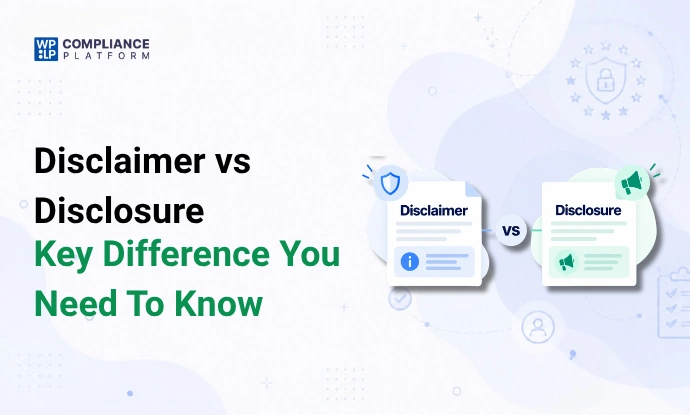
A disclaimer limits your liability (for example, “This is not medical advice”). A disclosure tells readers about a relationship or interest that could affect your content (for example, “I earn a commission from these links”). Most sites that earn money from content need both.
| Disclaimer | Disclosure | |
|---|---|---|
| What it does | Limits what you’re responsible for | Tells readers about a payment, relationship or data use |
| Who it protects | You, the site owner | Your readers |
| Required by law? | Usually not. No general law makes a website disclaimer mandatory. Some sectors have required wording (for example, the FDA statement on US supplement claims). | Often yes. Paid relationships must be disclosed in the US, EU and UK. Privacy laws require privacy disclosures. |
| Where it goes | Footer, a disclaimer page, or next to advice content | As close as possible to the recommendation, link or claim it covers |
| Example sentence | “This article is general information, not medical advice.” | “I get commissions for purchases made through links in this post.” |
| Common types | Medical, financial, legal, earnings, external links | Affiliate, sponsored content, material connection, privacy, cookies |
What is a disclaimer?
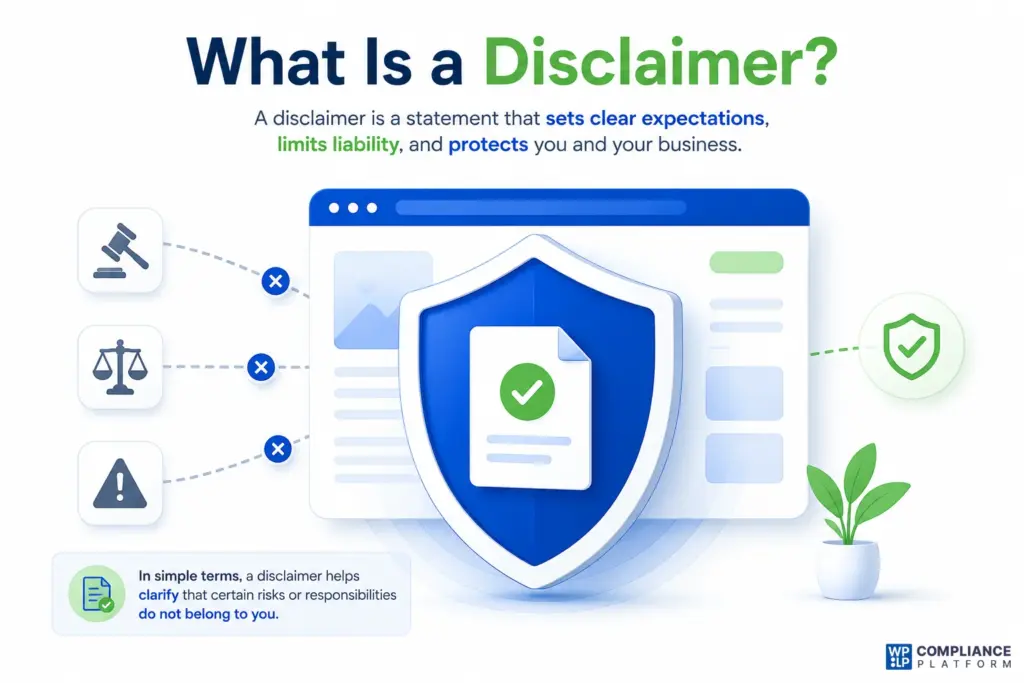
A disclaimer is a statement that limits your legal responsibility for how people use your content, products or services. Most say 2 things: “this is general information” and “talk to a professional before you act on it”. See what a website disclaimer is.
What is a disclosure?
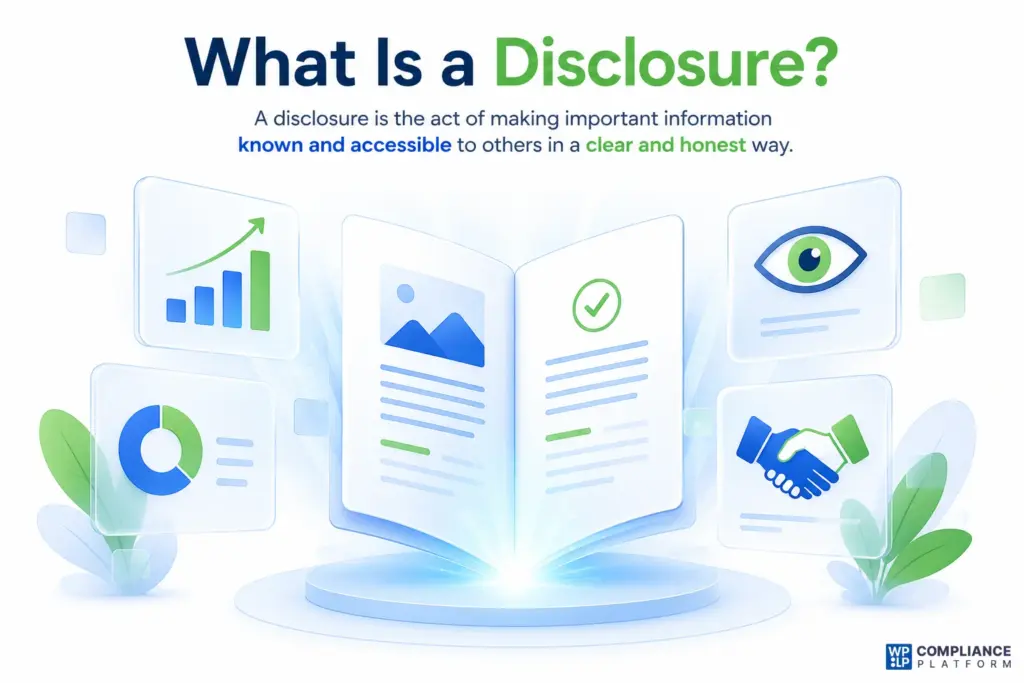
A disclosure tells readers something that could affect how they judge your content. On a website, that’s usually money: a commission, a free product, or a paid post. Privacy and cookie notices are disclosures too.
Which do you need? 4 scenarios
1. A blogger reviews a blender and links to Amazon
Needs: a disclosure.
The commission could affect the review, so readers need to know first. Put “I get commissions for purchases made through links in this post” inside the review, where the reader sees it and the link together. Add the Amazon Associates statement. A footer link alone won’t do, and neither will the words “affiliate link”. The FTC says readers may not know what that means.
2. A fitness creator posts a sponsored workout video
Needs: both.
The disclosure covers the money: say it at the start, show it when the product appears, and put it in the description above the “more” cut. The disclaimer covers the advice: “Talk to a doctor before you start a new exercise program.”
3. A personal finance blog with broker referral links
Needs: both.
The disclaimer says it isn’t financial advice. The disclosure says the blog earns a fee per account opened, and it goes next to each broker recommendation. Some countries have financial promotion rules that a disclaimer doesn’t satisfy, so get advice before you recommend investments.
4. A small business site with a contact form and analytics
Needs: privacy and cookie disclosures.
The site collects names, emails and analytics data, so it needs a privacy policy. In the EU and UK, most analytics cookies need consent first, so it also needs a cookie banner. It gives no advice, so a disclaimer is optional.
What the law requires in the US, EU and UK
“Required” means a law or regulator requires it. “Recommended” means it lowers your risk but no law makes it mandatory.
| Disclosures | Disclaimers | |
|---|---|---|
| US | Required: disclose material connections (payments, free products, commissions, family or business ties) clearly and close to the endorsement, under the FTC Endorsement Guides, 16 CFR Part 255 (revised 2023). Fake and undisclosed insider reviews are banned under the FTC rule on consumer reviews and testimonials, 16 CFR Part 465 (in force since October 21, 2024). Required: a privacy policy if you collect personal information from California residents (CalOPPA, and the CCPA for businesses that meet its thresholds). | Recommended for most sites. Required wording in some sectors, for example the FDA statement for dietary supplement structure/function claims (21 CFR 101.93). A disclaimer doesn’t cure a misleading claim. The FTC judges the overall impression of the page. |
| EU | Required: paid content must be identifiable as paid. Using editorial content to promote a product without making clear you were paid is banned outright (Unfair Commercial Practices Directive 2005/29/EC, Annex I, point 11). Required: privacy information under GDPR Article 13. Required: consent before non-essential cookies under the ePrivacy Directive (2002/58/EC, Article 5(3)). | Recommended. Consumer terms that exclude liability for death or personal injury are treated as unfair (Unfair Contract Terms Directive 93/13/EEC, Annex, point 1(a)). |
| UK | Required: ads must be obviously identifiable (CAP Code, section 2). Hidden paid editorial content is a banned practice under the Digital Markets, Competition and Consumers Act 2024, Schedule 20. Required: privacy information under UK GDPR. Required: consent before non-essential cookies under PECR. | Recommended. You can’t exclude liability for death or personal injury caused by negligence (Unfair Contract Terms Act 1977, s.2(1); Consumer Rights Act 2015, s.65). |
[PLACEHOLDER: legal reviewer to confirm this table, and whether to add Canada or Australia.]
Types of disclaimers
- Medical: health content is general information, not medical advice. See medical disclaimer examples from real health sites.
- Financial: not financial advice, and past results don’t predict future results.
- Legal: not legal advice, and no lawyer-client relationship. See how legal disclaimers work.
- Earnings: income examples aren’t promises. If you show standout results, also say what people usually get. “Results not typical” alone isn’t enough under the FTC Endorsement Guides.
- AI-generated content: AI tools helped write the content, so readers should check important facts.
- Views expressed: the opinions belong to the author, not their employer.
- Errors and omissions: you’re not responsible for mistakes or gaps.
- External links: you don’t control or endorse the sites you link to.
- Use at your own risk: for risky activities, within the limits in the region table.
A copyright line is a notice, not a disclaimer. See how to add copyright text to your website.
Earn money from links or testimonials? That needs a disclosure.
Types of disclosures
- Affiliate: you earn a commission on purchases through your links. Amazon Associates also requires its own statement. See why every affiliate site needs an affiliate disclosure policy and how to create an Amazon affiliate disclosure.
- Sponsored content: a brand paid for or shaped the post. “Sponsored by [Brand]” is clearer than “Sponsored” alone.
- Material connection: free products, a paid trip, family ties, employment or a stake in the company. If it could change how readers weigh your review, disclose it. See the FTC disclosure guidelines explained.
- Data privacy: what data you collect, why, who gets it, and visitors’ rights. See what a privacy policy needs to include.
- Cookies: which cookies you use and how to change the choice. See cookie notice vs cookie policy.
Copy-ready examples
Copy a line, then edit the parts in [brackets]. Change each one to match what your site actually does.
5 disclaimer examples
Medical disclaimer
The content on [Site Name] is for general information only and is not medical advice. Always talk to a doctor or other qualified health professional before you change your diet, exercise or treatment.Financial disclaimer
This content is for general information only and is not financial, investment or tax advice. Past performance does not predict future results. Talk to a licensed financial adviser before you make a financial decision.Legal disclaimer
This article explains the law in general terms and is not legal advice. Reading it does not create a lawyer-client relationship. For advice on your situation, talk to a qualified lawyer in your area.External links disclaimer
This site links to other websites. We do not control those sites and are not responsible for their content, products or privacy practices.AI-generated content disclaimer
Some content on [Site Name] was written with the help of AI tools and reviewed by our team. Check important information with an official source before you rely on it.5 disclosure examples
Affiliate disclosure (place it inside the post, near the first link)
I get commissions for purchases made through links in this post.Amazon Associates disclosure
As an Amazon Associate I earn from qualifying purchases.Sponsored content disclosure
Sponsored by [Brand]. [Brand] paid me to write this post. All opinions are my own.Free product (material connection) disclosure
[Brand] sent me this product for free to review. They did not see or approve this review before I published it.Cookie disclosure
We use cookies to run this site and, with your consent, to measure traffic and show ads. You can change your choice at any time in [Cookie Settings].Where to put disclaimers and disclosures
Disclaimers:
- A full disclaimer page, linked from your footer.
- A short line at the top or end of any post that gives medical, financial or legal information.
- Inside your terms and conditions. See privacy policy vs terms and conditions for what goes where.
- In videos and podcasts, say it out loud and add it to the description. See YouTube disclaimer examples.
Disclosures follow stricter rules. The FTC’s guidance is specific:
- Put it close to the recommendation. The FTC says a disclosure is most likely to be seen when it’s “very close to, or – even better – part of” the endorsement.
- The very top of the page can fail. A line above the post, outside the content, can be skipped because readers go straight to the headline and images. A line at the bottom is easy to miss too.
- One disclosure can be enough, sometimes. If the affiliate link sits inside the review and the reader can see the disclosure and the link at the same time, one disclosure may be adequate. In a long post with links far apart, repeat it near each recommendation.
- A home page or footer disclosure alone isn’t enough. Readers land on individual posts.
- Use words people understand. “Affiliate link” or a “Buy now” button on its own isn’t adequate. “Paid link” right next to the link should be.
- Video: disclose in the video and in the description near the links.
What a disclaimer can’t do
A disclaimer lowers risk. It doesn’t make you immune.
- It can’t make a false or misleading claim lawful. The FTC judges the overall impression of a page, so a “results not guaranteed” page won’t fix a “make $10,000 a month” headline.
- In the UK and EU, it can’t exclude liability for death or personal injury caused by negligence, or take away consumers’ legal rights.
- It works only if people can see it. Courts look at the wording, where it appears, and whether readers had a fair chance to read it.
FAQ
What does disclaimer mean?
A disclaimer is a statement that limits your responsibility for something. On a website, it usually says your content is general information and not professional advice.
Is an affiliate link a disclaimer or a disclosure?
A disclosure. You’re telling readers you earn money from the link. An “affiliate disclaimer” is the same thing under a different name, but the FTC calls it a disclosure.
Is it full disclaimer or full disclosure?
“Full disclosure” is the common phrase. It means you’re sharing everything relevant, often a personal or financial interest. “Full disclaimer” isn’t a standard phrase.
When should you use a disclaimer?
Use one when people could rely on your content and get hurt or lose money. That covers medical, financial, legal, fitness and education content, plus opinions and user-generated content.
Does a lawyer need to write my disclaimer?
No. Many site owners use a generator or template. If you work in a regulated field such as finance, health or law, have a qualified lawyer review your legal pages.
Create your disclaimer and disclosure pages with WPLP
Copying a disclaimer from another site causes most of the mistakes listed above: wrong laws, blanket liability lines, text that doesn’t match your site. WPLP Legal Pages writes the page from your own answers instead.
How it works:
- Answer a short questionnaire about your site: what you sell, what you recommend, how you earn, and what data you collect.
- Get a page that matches those answers, not a generic template.
- Publish it straight into WordPress with one click. There’s nothing to copy and paste from an outside generator.
- Add it to your footer automatically. When you change a policy, a banner can tell returning visitors what changed and when.
Cookies, covered by the same plan. WPLP Cookie Consent shows the consent banner from scenario 4. It blocks tracking scripts until a visitor says yes, and keeps a log of every consent decision in your WordPress database.
What it costs: the disclaimer and disclosure templates are part of the 30+ template library on paid plans, starting at $48/year for 3 sites. Every paid plan includes both plugins and a dashboard to manage all your sites from one login. Each one comes with a 30-day money-back guarantee.
One thing no tool does for you: the short disclosure line inside each post. That part is yours. See how to add a disclosure to your WordPress website for the full walkthrough.
Related reading